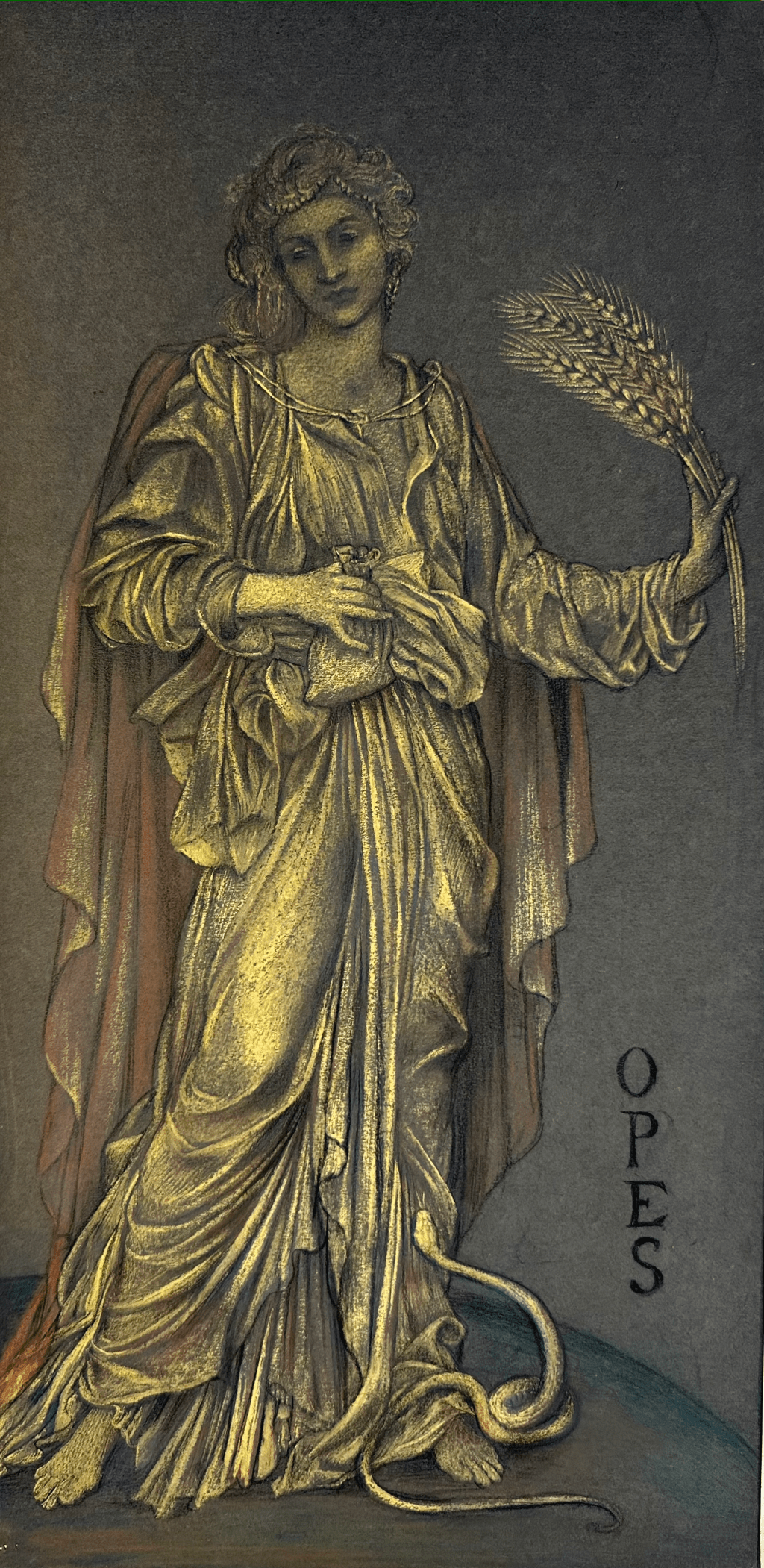
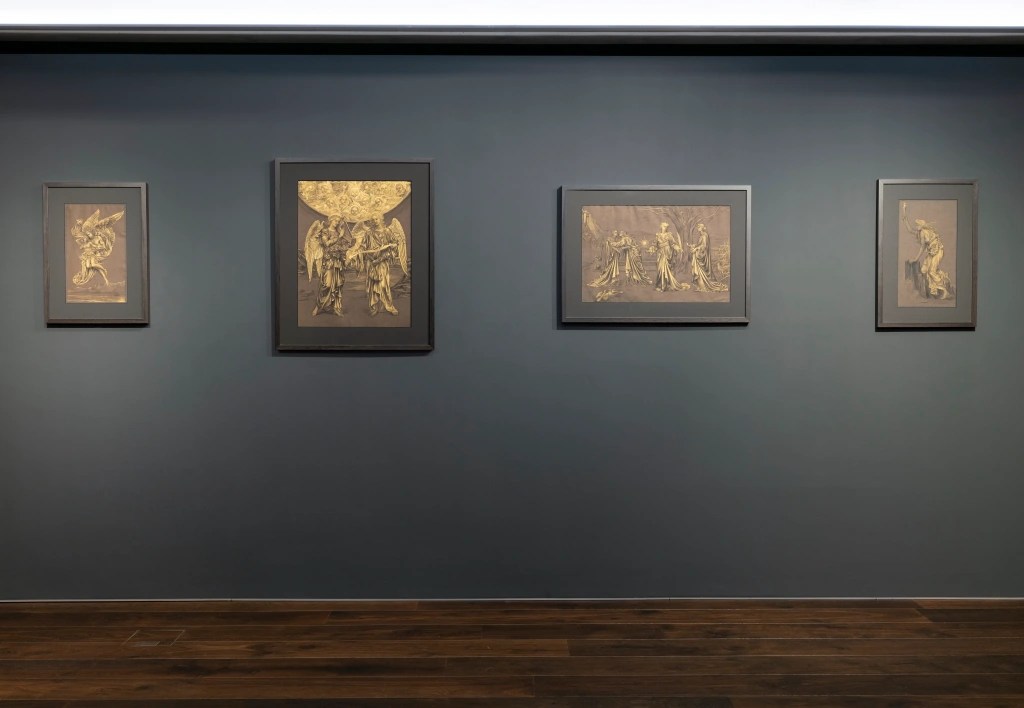
Downstairs in Leighton House is an art exhibition with a discreet charm: having escaped the crowds of High Street Kensington you descend a spiral staircase to find yourself, reverently silent, in a modest setting filled with gleaming paintings: the Gold Drawings of Evelyn De Morgan.
Leighton House, situated on leafy Holland Park Road in west London, is very much worth repeat visits in order to enjoy witnessing the changing of the seasons in the spacious and beautiful gardens, and to to take a close look at the many artworks and scheduled temporary exhibitions taking place within. The building was the home of artist Frederic Leighton, and is now Grade II listed: what I find particularly fascinating is the remarkable Arab Hall composed of 14-16th century tiles collected by the artist during his trips to the Middle East, as well as the sense of intimacy the house imparts: Leighton’s personal effects are on display alongside his most renowned paintings – here, overlooked by Leighton’s magisterial final painting Clytie, a handwritten letter from Leighton rests on an escritoire as gingerly as though he’d left it there ten minutes, rather than over a century, ago; there, in the north-facing studio on the first floor, a dozen or so easels are set up facing the large windows, giving the impression that the artist has just stepped into the next room to set up his colour palette.
It is in these surrounds that the Evelyn De Morgan exhibition finds a home: De Morgan, we learn, trained at the Slade School of Art, later becoming an accomplished professional artist across a range of media: she was born in 1855 and died in 1919. The Gold Drawings, largely created in the 1890s, were among the fruit of De Morgan’s forties: at the time of their being presented to the public, De Morgan was a well-known if not quite household-name painter in England. A pre-Raphaelite, De Morgan’s usual style was to depict the long, Botticellian hair and soulful expressions of young, pensive women: the Gold Drawings enable us to view her draughtsmanship all the more clearly, as the figures burnished in gold are rendered in relief against backgrounds of dark grey paper.
De Morgan did not keep a diary and there exist no contemporaneous sources as to her working methods; however, curator Sarah Hardy explained that through a close reading of the purchase ledger accounts of De Morgan’s art supplier, she was able to see that the artist bought gold pigment from the supplier in the form of cakes, which she then would grind down to create a powder to be made into a kind of pen with the additions of water and gum Arabic. These were, Hardy explained, art materials of De Morgan’s own invention, albeit building upon reasonably similar tools made by Edward Burne Jones. Gold, Sarah Hardy related, was ubiquitously used by Renaissance painters to signify the divine; similarly, De Morgan uses gold to represent salvation.
Spotting the same beatific faces cropping up across the selection of paintings shown, I was curious to know whether De Morgan worked from life models, or from reference drawings: curator Sarah Hardy surmised that De Morgan worked from drawings, as the artist’s process of drawing with gold was painstakingly long and therefore to ask a life model to sit for days on end may prove challenging. This perhaps explains why the faces of the Gold Drawings are somewhat uniform, albeit transcendentally beautiful.
As an exhibition, Evelyn De Morgan: Gold Drawings is quite unique in that visitors will feel like they’re inside a jewellery box: a compact, darkly lit space set aglow by the golden figures. They will, without thinking, bend at the knee and narrow their eyes in order to catch each painting’s best angle so that it catches the light: when on target, the effect is truly mesmerising.
Evelyn De Morgan: The Gold Drawings runs at Leighton House, London W14 to 27 August 2023.
IMAGE TOP: Evelyn De Morgan, Opes (1900), Royal Borough of Kensington & Chelsea (Image: Jaron James)
 Frances Forbes-Carbines