We are told continually how good it is for us to “get outdoors”, to leave the confines of the sofa, to step away from the workplace desk and to take a leisurely walk, a jog, or a run, in nature.
We are told it’s good for creativity, for productivity; that at the very least it’s good exercise and that we’ll feel better, that worries will somehow become less intensive. There are numerous studies that attest to this.
Yet often it feels like the hardest thing in the world to do. Three constraining factors are time, opportunity and the will to do so.
I went recently to a local park, feeling depressed as anything. The heat and light felt both oppressive and annoying. I walked unthinkingly, head bent, a heaviness in my tread. I felt irritated at myself for seemingly not benefiting from the great outdoors and irritated at proponents of walking in nature. Why wasn’t it working?
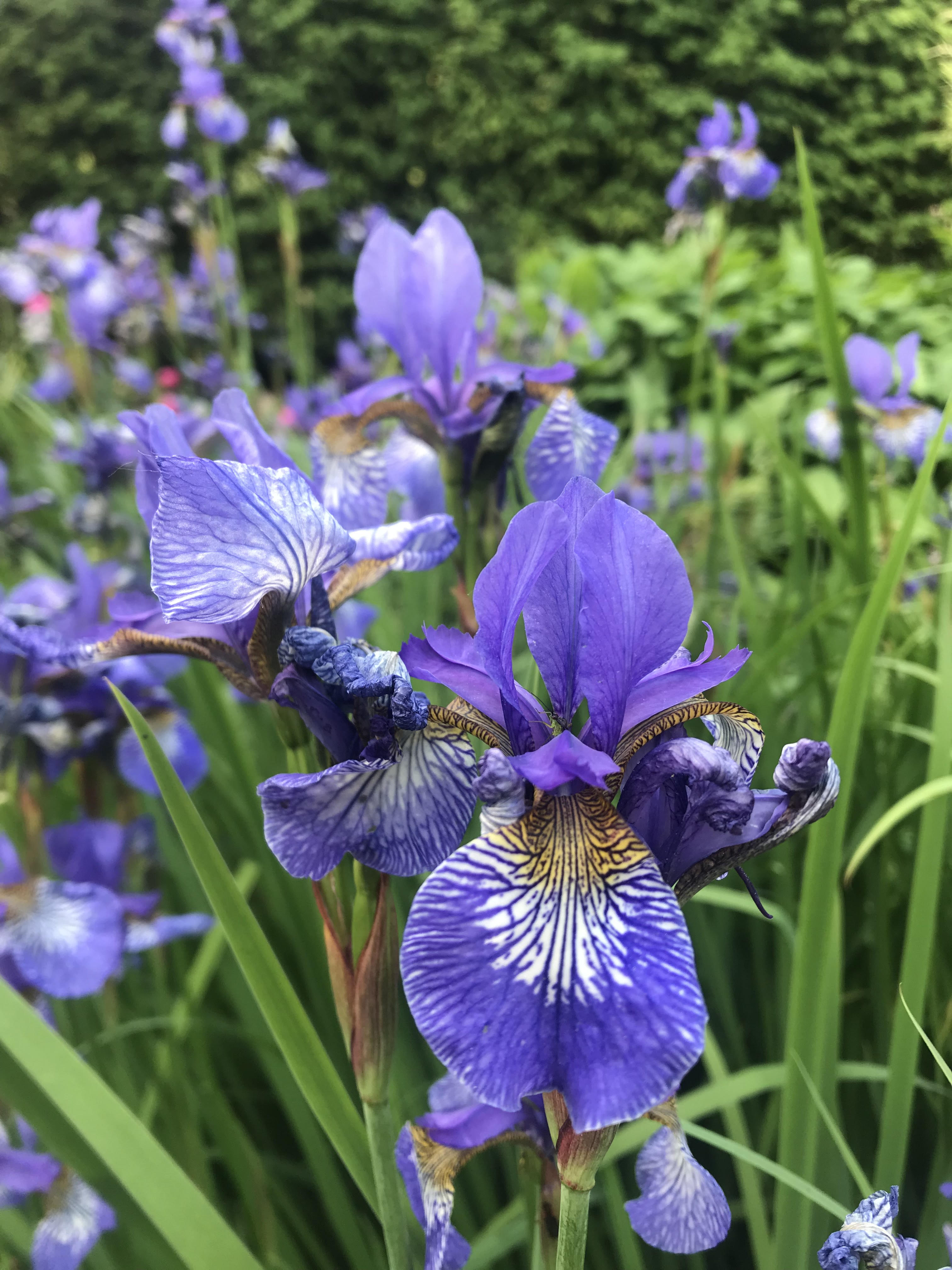
Then I noticed some majestic looking irises. I recognised what kind of flower they were not from my knowledge of horticulture (minimal) or amount of time spent in nature (also minimal) but from the art of Vincent Van Gogh, who famously painted irises. I don’t think I have ever viewed one of Van Gogh’s iris paintings in person, but I’ve seen them reproduced in books, postcards and online. And here before me, withstanding the oppressive heat and light were irises. Definitely irises. They are quite unmistakable.
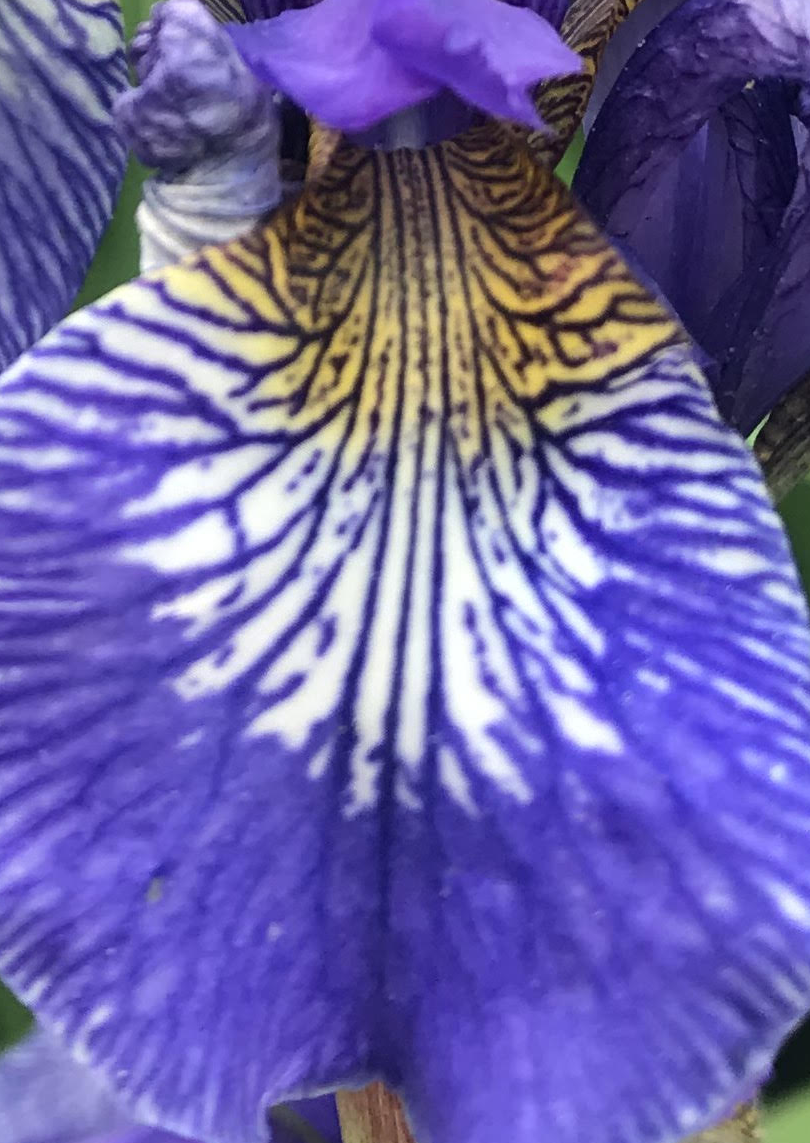
Detail of an iris
My worries were replaced, in walking, with thoughts about colour, and irises, and Van Gogh, and thought particularly about his own mental health, and whether being outside had made him feel any better, even if momentarily. It is known that he tragically took his life while in the fields, after all.
We are lucky in that we can trace Van Gogh’s thoughts and feelings through his letters: over 900 of them have thankfully survived the passage of time, and also lucky in that they have been digitised and are available online in Dutch, French and English.
In a letter to his friend Emile Bernard, Van Gogh writes:
These meadows are intersected in the foreground by a ditch full of purple irises. They cut the grass while I was painting, so it’s only a study and not a finished painting, which I intended to make of it. But what a subject — eh — that sea of yellow flowers with a line of purple irises […]
Vincent Van Gogh to Emile Bernard, Arles 22 May 1888
He is clearly taken with the subject matter – does the convivial, upbeat tone of the letter imply he is happy? A sadder letter, also mentioning irises, but also detailing his experiences in the asylum of Saint-Rémy in Provence is addressed to his brother, Theo, in 1889:
I wanted to tell you that I think I’ve done well to come here, first, in seeing the reality of the life of the diverse mad or cracked people in this menagerie, I’m losing the vague dread, the fear of the thing. And little by little I can come to consider madness as being an illness like any other. Then the change of surroundings is doing me good, I imagine.
As far as I know the doctor here is inclined to consider what I’ve had as an attack of an epileptic nature. But I haven’t made any enquiries.
Have you by chance yet received the crate of paintings, I’m curious to know if they’ve suffered more, yes or no. I have two others on the go — violet irises and a lilac bush. Two subjects taken from the garden.
The idea of my duty to work comes back to me a lot, and I believe that all my faculties for work will come back to me quite quickly. It’s just that work often absorbs me so much that I think I’ll always be absent-minded and awkward in getting by for the rest of life too.
Vincent to Theo Van Gogh, Saint-Rémy-de-Provence, 9 May 1889
Van Gogh had voluntarily admitted himself into the asylum of St.-Paul-de-Mausole asylum in Saint-Rémy, and painted Irises in the gardens of the mens’ quarters. Theo, on receiving the painting and noting its reception when exhibited, wrote back to Vincent that it “strikes the eye from afar. It is a beautiful study full of air and life“.
The paintings are overwhelmingly beautiful, and a delight to look upon, but it’s difficult to say with any real degree of objectivity whether Van Gogh was any happier when in nature. He certainly was happiest when painting, and there’s a serenity in knowing from the letters that being in nature and appreciating the beauty of the great outdoors provided Van Gogh with some degree of respite, however fleeting, from his depression.

 Frances Forbes-Carbines
Leave a comment